A wheel bearing is a relatively small component with a major influence on road safety, ride quality and workshop reputation. When wheel bearings begin to wear, the vehicle may develop a low hum, steering instability or uneven tyre wear. Left unresolved, a failing bearing can create heat, damage the hub assembly and, in severe cases, affect wheel retention.
For workshops, fleet operators and parts dealers, the priority is not simply replacing a noisy component. It is identifying the correct cause, selecting a dependable replacement and ensuring the part is fitted to the manufacturer’s specification. That approach protects the repair, reduces repeat work and gives drivers confidence on every journey.
What wheel bearings do
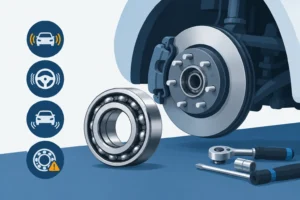
Wheel bearings allow each road wheel to rotate smoothly while supporting the vehicle’s weight and resisting the forces created by braking, cornering and uneven road surfaces. They sit within the hub or, on some applications, are fitted as part of a complete hub bearing unit.
Modern vehicles commonly use sealed ball bearing or angular-contact bearing assemblies. These are designed to manage both radial load, created by the vehicle’s weight, and axial load, created during turning. Many newer hub units also incorporate an ABS sensor ring or magnetic encoder, making correct fitment and careful handling particularly important.
Older vehicles and some commercial applications may use serviceable tapered roller bearings. These require the correct grease, adjustment and sealing procedure. Although their design differs from a sealed hub unit, the operating principle remains the same: minimise friction while keeping the wheel accurately located under load.
Warning signs of worn wheel bearings
A droning, rumbling or growling noise that increases with road speed is the most familiar symptom. Unlike an engine-related noise, it will often remain present when the vehicle is coasting in neutral. The sound may change when the driver gently loads one side of the vehicle through a bend, although this is an indicator rather than a definitive diagnosis.
Other signs deserve attention. A technician may detect excessive play when checking the wheel, feel roughness when rotating it by hand, or find evidence of grease leakage around a damaged seal. On vehicles with integrated wheel-speed sensing, a warning lamp or intermittent ABS fault can also point towards a bearing or encoder issue.
Tyre noise can be mistaken for bearing noise, particularly when tyres are unevenly worn or have developed a saw-tooth pattern. Brake drag, a damaged CV joint and differential faults can also produce similar sounds. A proper inspection therefore matters more than replacing parts on the basis of noise alone.
When the vehicle should not be driven
Visible wheel movement, severe grinding, a hot hub, smoke, or a wheel that feels loose require immediate attention. Continuing to drive may damage the hub, driveshaft, steering knuckle or brake components, turning a straightforward repair into a more costly job. For fleet vehicles, prompt withdrawal from service also avoids an avoidable safety and compliance risk.
Why wheel bearings fail
Normal wear is one cause, especially on high-mileage vehicles operating under regular load. However, premature failure often has an underlying reason. Water and road contamination can enter through a damaged seal, degrading the lubricant and corroding bearing surfaces. Impact damage from potholes, kerbs or poor road conditions can mark the races or distort the hub.
Incorrect installation is another common source of early failure. Pressing force through the wrong bearing race, reusing a damaged hub, over-tightening or under-tightening the axle nut, and fitting the wrong torque specification can all place damaging loads on the assembly. A wheel bearing may appear acceptable immediately after installation but become noisy soon afterwards.
Heat also matters. A sticking brake caliper can transfer excessive heat into the hub area, affecting lubricant performance and seal life. Overloading a van, lorry or trailer places additional stress on bearings, tyres and suspension components. These conditions should be corrected alongside the bearing replacement, not treated as separate issues.
Diagnosing the fault before ordering parts
A disciplined diagnosis protects both the workshop and the customer. Start with a road test where safe and appropriate, listening for changes in noise under light cornering load. Back in the workshop, raise the vehicle securely and inspect each wheel for free rotation, play, tyre condition and brake drag.
Wheel movement at the 12 and 6 o’clock positions can indicate a bearing issue, but it may also relate to suspension joints. Movement at 3 and 9 o’clock can point to steering components. The checks should be interpreted alongside the vehicle’s suspension design and the manufacturer’s procedures.
Where ABS faults are present, inspect the sensor connection, wiring and encoder area before condemning the bearing. A diagnostic scan can help identify the affected wheel, but it does not replace a physical inspection. Rust, debris or incorrect sensor air gap can create signal faults even when the bearing itself remains serviceable.
For trade customers, accurate vehicle identification is essential before supply. Confirm the registration details, VIN where available, axle position, engine variant, braking system and whether the vehicle uses an integrated hub assembly. Similar-looking parts can have different flange dimensions, sensor configurations, spline counts or bolt patterns.
Choosing replacement wheel bearings for reliable repairs
The lowest purchase price is rarely the true cost of a bearing. A poor-quality unit can lead to noise complaints, warning lights, repeat labour and lost customer confidence. Quality replacement parts should be manufactured to precise tolerances, use suitable sealing and lubrication, and be designed for the loads expected on the application.
For a sealed bearing, confirm whether the repair requires the bearing alone, a hub assembly, a mounting flange or a complete kit. Where a kit includes an axle nut, circlip, bolts or seal, those items are often included for a reason. Fasteners may be single-use or specified for a particular tightening method.
ABS-equipped applications need additional care. The encoder side must face the sensor, where applicable, and magnetic encoder rings should be kept away from contamination and strong magnets. Damage that cannot be seen easily may create an ABS warning after the mechanical repair appears complete.
Multi Top supports workshops and trade buyers with dependable replacement parts across essential service and repair categories. Choosing a supplier with consistent stock availability and knowledgeable fitment support helps reduce delays when a vehicle is already occupying a service bay.
Fitting practices that protect the new bearing
A quality bearing can fail prematurely if installation methods are poor. Clean the hub bore and mating surfaces thoroughly, removing corrosion without damaging the seating area. Inspect the hub and steering knuckle for scoring, distortion or heat damage before fitting the replacement.
When pressing in a bearing, apply force only to the race being fitted. Pressing through the rolling elements transfers force across the bearing and can create internal damage before the vehicle leaves the workshop. Likewise, when installing a hub into a fitted bearing, support the inner race correctly.
Torque settings are not a matter of judgement. Use the vehicle manufacturer’s tightening sequence, torque figure and angle procedure where specified. An impact gun should not be relied upon as the final tightening method for an axle nut or hub fastener. After reassembly, verify free wheel rotation, brake operation and the absence of warning lights.
A short post-repair road test, where conditions permit, is worthwhile. It can reveal a disturbed sensor connection, abnormal brake drag or a noise that was not related to the bearing in the first place. This final check is particularly valuable for fleet vehicles that need dependable return-to-service decisions.
Stock planning for workshops and dealers
Wheel bearing demand is often reactive, but sensible stock planning can reduce lost time. Fast-moving applications are typically shaped by the local vehicle parc, fleet contracts, common van models and the age profile of vehicles serviced. Tracking repeat requests by make, model and axle position gives a clearer basis for inventory decisions than stocking by assumption.
Bearings should be stored in clean, dry conditions and kept in their original packaging until required. Avoid opening sealed units early or placing them near grinding dust and workshop contamination. For dealers, supplying complete, correctly matched kits can also reduce the risk of a technician discovering a missing nut, bolt or sensor-related component halfway through a repair.
The right wheel bearing repair is built on careful diagnosis, correct fitment and parts that are made to withstand real operating conditions. Treat the component as a safety-critical part rather than a routine commodity, and each replacement becomes a stronger contribution to vehicle reliability and customer trust.