A clutch job can tie up a ramp, delay a customer collection and damage workshop confidence if the replacement parts do not fit correctly. Choosing the right clutch kit replacement supplier is therefore not simply a purchasing decision. It affects repair quality, labour efficiency, warranty exposure and the reputation a business builds with every completed vehicle.
For dealers, workshops and fleet support teams, the strongest supplier is one that combines dependable product quality with accurate application support, consistent availability and commercially sensible pricing. A clutch kit may be a service part, but it is also a high-consequence repair: fitting the wrong kit or a short-life component can turn one invoice into an avoidable return visit.
What a dependable clutch kit should deliver
A clutch system transfers engine power to the gearbox while allowing the driver to disengage drive for gear changes and stationary starts. Its components work under heat, friction and repeated load. When wear progresses, drivers may notice slipping under acceleration, difficulty selecting gears, clutch judder, a heavy pedal or unusual noise when the pedal is pressed.
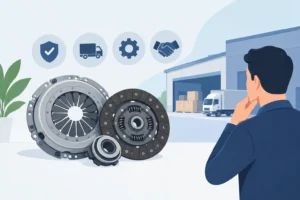
A replacement kit commonly includes a friction disc, pressure plate and release bearing. Depending on the vehicle application, the repair may also require a concentric slave cylinder, pilot bearing, clutch fork components or new flywheel bolts. The exact contents matter. Supplying a kit with the correct main parts but overlooking a hydraulic release bearing can create an unnecessary delay once the gearbox is removed.
Quality is not defined by appearance alone. The friction material needs stable engagement characteristics, the pressure plate must maintain appropriate clamping force, and the bearing must operate smoothly over its intended service life. For workshops, this translates into reliable pedal feel, predictable drive-away performance and fewer claims after installation.
Choosing a clutch kit replacement supplier for trade work
The right supplier understands that a part number is only one part of the transaction. Trade customers need stock that can be identified, supplied and supported with minimal disruption to the working day.
Fitment accuracy comes first
Vehicle make, model and registration year are useful starting points, but they are not always enough. Manufacturers can use different gearbox codes, engine variants, flywheel arrangements and release mechanisms within the same model range. A supplier should be able to help confirm the correct kit using the most accurate available vehicle information, including VIN, engine code, gearbox code, original equipment references and plate dimensions where required.
This level of checking is particularly valuable for vehicles with dual-mass flywheels, self-adjusting clutches and hydraulic release systems. These applications are often less forgiving of assumptions. A kit that appears visually similar may have a different spline count, diameter, diaphragm design or bearing configuration.
Good fitment support protects more than the parts margin. It prevents lost technician time, avoids vehicle-off-road extensions and helps a workshop give customers a firm collection time with greater confidence.
Product quality must suit the repair and vehicle use
The lowest-priced clutch kit is not automatically the best value. A private vehicle used mainly for short local journeys has different demands from a delivery van, taxi, fleet vehicle or light commercial vehicle that carries regular loads. Frequent stop-start use, towing and high mileage place greater stress on the clutch assembly.
A capable supplier should offer a quality-led range and provide clear guidance when an application calls for a more durable option. This does not mean overspecifying every repair. It means matching the component to the vehicle, expected duty cycle and customer budget without compromising safe operation or reliability.
For trade buyers, consistency across repeat purchases is equally valuable. When a workshop knows the supplied kits provide sound fitment and dependable service, estimators can quote with confidence and technicians can work to familiar installation standards.
Availability should support real workshop schedules
A vehicle on a lift with its gearbox removed is not a future order. It needs the correct component quickly. This is why inventory depth and practical stock management are central to supplier selection.
Ask whether the supplier carries coverage across common passenger car and commercial applications, rather than a narrow selection of fast-moving references. Consider how back orders are handled, whether alternatives can be identified when appropriate, and how clearly availability is communicated before work is committed.
A broad parts distributor can offer an additional operational advantage. Clutch repairs often uncover related needs, such as gearbox seals, engine mounts, hydraulic components, flywheel bolts, filters or service items. Consolidating these requirements through one knowledgeable source can reduce administration, simplify invoicing and keep repairs moving.
Technical support should be practical, not generic
Even experienced technicians encounter difficult fault patterns. A slipping clutch may be caused by worn friction material, but it can also point to oil contamination, a damaged flywheel surface, a release issue or an incorrect previous installation. Judder may originate from a distorted pressure plate, worn engine mounts or an unsuitable flywheel condition.
A reliable supplier does not diagnose a vehicle from a distance, but it should provide informed product guidance when questions arise. This includes confirming kit contents, advising on associated replacement components and helping buyers avoid common fitment errors. Clear communication before ordering is always less expensive than resolving a mismatch after fitting.
Assess the full clutch repair, not only the kit
A replacement clutch works best when the surrounding system is inspected properly. Treating the kit as an isolated component can shorten the life of an otherwise good repair.
The flywheel deserves close attention. A conventional solid flywheel may be suitable for resurfacing only where the manufacturer specification and its condition allow it. A dual-mass flywheel should be assessed for rotational free play, rocking movement, heat damage and surface condition. Reusing a worn dual-mass flywheel with a new clutch can lead to vibration, noise and premature failure.
Oil leaks must also be addressed before reassembly. Contamination from a rear crankshaft seal or gearbox input seal can quickly affect the new friction disc. The release mechanism, clutch cable or hydraulic circuit should be checked for smooth operation, while engine and gearbox mounts should be examined where vibration or harsh engagement has been reported.
This is where supplier support adds genuine value. A supplier that carries related service and engine components can help workshops source the necessary parts without splitting the order across multiple vendors or compromising on repair scope.
Commercial value is more than the unit price
Part cost remains a significant consideration, especially for dealers managing competitive quotations and workshops handling varied customer budgets. However, the true cost of a clutch kit includes the time required to fit it, the risk of return work and the impact of a delayed vehicle handover.
A competitively priced kit with uncertain fitment can become costly once labour, recovery arrangements and customer dissatisfaction are considered. Conversely, a dependable part supported by accurate catalogue data and responsive assistance can protect margin even if its initial price is not the lowest on the quote.
For regular trade purchasing, look for transparent account support, flexible ordering options and a supplier prepared to build a long-term working relationship. Multi Top brings more than 30 years of aftermarket experience to this requirement, supplying quality replacement parts across service, engine and body categories for businesses that value dependable availability and clear guidance.
Questions worth asking before placing an order
Before committing to a new supply relationship, establish how the supplier verifies vehicle application, what is included in each clutch kit and whether related hydraulic or flywheel components are available. Confirm the approach to stock availability, technical queries, returns and warranty matters. These conversations reveal far more about supplier reliability than a price list alone.
It is also sensible to assess consistency over several orders. The best supplier relationship is built when the correct parts arrive as expected, product information is clear and support remains available when an unusual vehicle or difficult diagnosis appears.
A clutch replacement is a labour-intensive repair with little room for guesswork. Selecting a supplier that treats fitment, quality and aftersales support with the same care as the workshop will help every completed repair leave the ramp ready for dependable service.