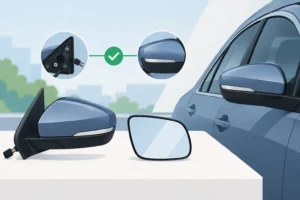
A replacement door mirror may look like a straightforward body part, but the wrong unit can create immediate problems: poor rearward visibility, an inoperative heater, an incorrect electrical connector, or a housing that simply will not sit correctly on the door. Knowing how to match replacement mirrors accurately protects road safety, avoids repeat fitting work and preserves confidence in every repair.
For workshops, dealers and fleet support teams, mirror matching is also an efficiency issue. A part ordered by appearance alone can delay vehicle turnaround and leave stock tied up in the wrong application. The correct approach is to verify the vehicle, its original mirror specification and the required functions before selecting the replacement.
Start with the exact vehicle application
The registration number, vehicle identification number (VIN), make, model and model year provide the starting point, but they are not always enough by themselves. Manufacturers often change mirror designs during a production run, particularly after a facelift or when a model is offered in several trim levels. A mirror for a 2018 vehicle, for example, may differ from one fitted to the same model late in 2018.
Confirm the body style as well. Hatchbacks, saloons, estates, vans and commercial derivatives can use different mounting points or mirror housings despite sharing a model name. For trade customers handling regular repairs, recording the full application information at the quotation stage reduces the risk of incorrect supply later.
Where possible, identify the original equipment part number from the existing mirror or manufacturer catalogue. This is one of the most reliable ways to cross-reference an aftermarket replacement. If the label is missing or unreadable, clear photographs of the fitted unit, mounting area and electrical connector give a supplier valuable information for a fitment check.
How to match replacement mirrors by position and mounting
A left-hand mirror is not merely the same component reversed. The mounting base, glass shape, viewing angle, indicator position and wiring route can all differ between the near-side and off-side. Always establish which side is required before ordering. For right-hand-drive vehicles used in Great Britain, the driver’s mirror is on the off-side, while the passenger mirror is on the near-side.
Next, inspect the mirror base. Its outline must match the door mounting point, including the position of fixing screws or studs. Check whether the existing assembly uses a triangular sail-panel trim, a separate gasket or an integrated mounting cover. An apparently similar housing with a different base will not provide a secure or weather-resistant installation.
It is worth checking whether the replacement is supplied as a complete assembly or as an individual component. A complete mirror commonly includes the housing, glass, motor and mounting base. In other cases, only the mirror glass, cover or indicator lens is needed. Replacing a complete assembly when only the glass is damaged may increase repair cost unnecessarily. Conversely, fitting a new glass to a damaged folding mechanism is a false economy.
Match every fitted function, not just the housing
Modern mirrors often contain more technology than their exterior appearance suggests. A basic manually adjusted unit and an electrically folding, heated mirror can share a similar housing while requiring entirely different wiring and internal components. The replacement must meet the vehicle’s required specification.
Check whether the original mirror has electric adjustment. This can usually be confirmed from the switch inside the vehicle and from the connector on the assembly. Count the connector pins, but do not rely on pin count alone: connector shape, keying and wire arrangement also matter.
Heated mirror glass is another common feature. It clears condensation and light frost through an electrical element behind the glass. A non-heated replacement may physically fit, but it removes a useful safety function and may leave unused wiring. For fleet vehicles and daily-use cars operating in wet or cold conditions, maintaining this feature is particularly worthwhile.
Electric folding is equally important to verify. Some mirrors fold at the touch of a switch, while others fold manually. A replacement without the correct folding motor will not restore the original operation. If the vehicle is regularly used in narrow streets, car parks or trade premises, this is not a minor convenience feature.
Other functions can include integrated direction indicators, puddle lamps, blind-spot warning lights, cameras, memory positioning and auto-dimming glass. These systems should be treated as specification-critical. A mirror with a camera or warning indicator may require calibration or diagnostic work after fitting, depending on the vehicle. Confirm this before promising a repair completion time.
Check glass type, field of view and finish
Mirror glass is available in flat, convex and aspheric designs. Convex glass gives a wider field of view, while aspheric sections reduce blind spots further. The wrong glass can alter the driver’s perception of distance and may not meet the original design specification. Match the shape, curvature and any etched markings on the existing unit.
Blue-tinted or anti-glare glass should also be replaced with an equivalent where fitted. These details affect driver comfort and visibility in headlights, especially during night driving. For heated glass, ensure the terminal layout matches the vehicle wiring and that the backing plate clips correctly into the motor carrier.
Finish matters for both repair quality and customer satisfaction. Mirrors may be textured black, satin black, primed for painting, colour-coded or finished with chrome-effect details. A primed cover can be the correct economical choice when the bodyshop will paint it to match. On the other hand, a ready-finished black housing may suit commercial vehicles where speed and durability take priority over cosmetic refinishing.
Do not assume a painted cap from one mirror will transfer to another. Retaining tabs and housing profiles can vary between years and trim grades. Check compatibility before reusing an undamaged cover.
Compare the connector before fitting
An electrical connector is one of the clearest indicators of whether a replacement mirror is suitable. Compare it directly with the original part before the assembly is installed. Look at the connector body, locking tab, pin arrangement and cable length. A connector that almost fits should not be forced, altered or adapted without a verified wiring solution.
This check should happen before dismantling the door trim where practical. It can save workshop time and help identify an incorrect part while the vehicle remains available for comparison. For volume repair operations, a simple intake process that records connector photos alongside vehicle details can reduce avoidable returns.
After installation, test every function before refitting interior trims or releasing the vehicle. Confirm glass adjustment in all directions, heating operation where conditions allow, folding function, indicator operation, camera image and any warning light system. Listen for unusual motor noise and confirm that the mirror locks securely in its normal driving position.
Consider quality, not only purchase price
A lower-priced mirror that fits poorly, vibrates at speed or fails after a short period can cost far more than the initial saving. Housing stiffness, motor reliability, glass retention and weather sealing all influence long-term performance. This is especially relevant for fleets, workshops managing warranty exposure and dealers protecting repeat business.
A quality aftermarket replacement should be selected for accurate fitment and dependable operation, not simply because it resembles the original component in a catalogue image. Work with a supplier that can support application checks, provide consistent product information and maintain dependable stock across common vehicle ranges.
With more than 30 years of aftermarket experience, Multi Top supports trade and individual buyers with quality-focused replacement parts and practical guidance where fitment needs clarification. The objective is straightforward: source the correct component first time, keep repairs moving and deliver a result the driver can rely on.
A matched replacement mirror does more than complete the appearance of a vehicle. It restores the visibility, functions and confidence that the vehicle was designed to provide – and that is what turns a routine parts replacement into a dependable repair.