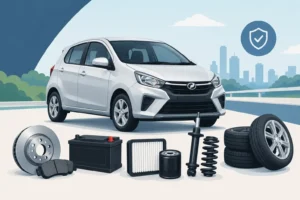
A Perodua Axia earns its place through practical, economical motoring. For workshops, parts dealers and owners alike, keeping that reliability intact depends less on dramatic repairs and more on fitting the right replacement parts before routine wear becomes downtime, poor performance or a safety concern.
The Axia is commonly used for daily commutes, delivery rounds and family travel, often covering substantial mileage in stop-start conditions. That makes disciplined servicing and dependable parts selection commercially sensible. A low-cost component that fails early can create repeat labour, customer dissatisfaction and avoidable vehicle-off-road time. Quality replacement parts help protect the value of every service job.
The service parts that matter most on an Axia
Routine service components are the foundation of Axia maintenance. Oil filters, air filters, spark plugs, drive belts and fluids may be relatively small items, but their condition affects engine protection, fuel use and day-to-day drivability.
An oil filter should be replaced at the interval specified for the vehicle and alongside the correct grade of engine oil. Its role is to trap contaminants before they circulate through the engine. Delaying replacement can allow oil flow and lubrication quality to deteriorate, particularly where the car is regularly driven in congested traffic or on short journeys.
The engine air filter also deserves proper attention. A blocked filter restricts incoming air and can contribute to reduced response and inefficient combustion. In dusty operating conditions, inspections may be needed more frequently than a fixed mileage schedule suggests. For a workshop, checking the air filter at every service is a straightforward way to identify a genuine maintenance requirement and provide clear advice to the owner.
Spark plugs are equally important for smooth starting and combustion. Misfiring, rough idling, hesitation under acceleration or a noticeable increase in fuel consumption can indicate worn plugs, although diagnosis should not stop there. Ignition coils, fuel supply and sensor faults can create similar symptoms. Replacing parts based on evidence rather than assumption protects both the vehicle owner and the workshop’s reputation.
Choosing filters and belts with confidence
Correct fitment is not optional. Filters with poor sealing, incorrect thread specifications or unsuitable dimensions can compromise an otherwise routine service. The same principle applies to auxiliary drive belts. A belt that is glazed, cracked, frayed or noisy should be inspected promptly, along with the associated pulleys and tensioning components.
Trade customers benefit from a supplier that can identify compatible service parts accurately and maintain dependable stock availability. This reduces the risk of holding up a service bay while a basic consumable is sourced elsewhere. For independent owners, expert fitment guidance provides the confidence that a part is appropriate for their exact vehicle variant.
Axia braking parts are a safety priority
Braking components should never be selected on price alone. Brake pads, discs, drums, shoes, hydraulic components and brake fluid all work as a system. The objective is predictable, consistent braking performance in normal traffic as well as during an emergency stop.
Owners may report squealing, grinding, vibration through the pedal, pulling to one side or increased stopping distance. These signs need a full inspection rather than an automatic pad replacement. Uneven wear can point to sticking calipers, damaged slide pins, disc condition or issues elsewhere in the braking system. Fitting new pads without addressing the cause can lead to another premature repair.
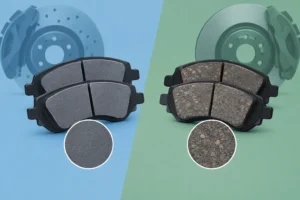
Quality brake pads should offer stable friction characteristics, sensible noise control and material durability suited to everyday road use. Brake discs must be checked for wear, scoring, corrosion and thickness against the vehicle manufacturer’s limits. If replacement is necessary, fitting compatible pads and discs together is often the best approach to achieve an even bedding-in process and reliable performance.
Brake fluid is sometimes overlooked because it is not visible during normal driving. However, it absorbs moisture over time, which can reduce its boiling point and contribute to internal corrosion. Following the recommended replacement interval helps preserve braking response and the service life of hydraulic components.
Suspension and steering affect more than comfort
A harsh ride, excessive body movement or uneven tyre wear is not simply an inconvenience. On an Axia, worn shock absorbers, suspension bushes, ball joints or steering components can reduce stability and tyre contact with the road.
Shock absorbers should be assessed when there is bouncing after bumps, nose-diving under braking, fluid leakage or a less controlled feel on uneven surfaces. Their role is to manage spring movement, so a vehicle can remain composed through corners and during braking. Replacing worn units in axle pairs supports balanced handling.
Suspension inspection should also include bushes, links and mounting points. Rubber components can harden or crack with age, heat and road exposure. Small amounts of play may develop gradually, which is why customers do not always notice the change until tyre wear or noise becomes obvious.
Steering parts require the same care. A loose steering feel, knocking over rough roads or irregular tyre wear may indicate wear in track rod ends or related components. Once repairs are completed, wheel alignment should be checked where relevant. Alignment is not an add-on to be ignored: it is essential to avoid damaging new tyres and to maintain predictable handling.
Cooling and fuel system checks prevent disruption
A cooling-system fault can turn a modest repair into serious engine damage if overheating is ignored. Radiators, hoses, water pumps, fans, caps and coolant all need to perform reliably, particularly in heavy traffic where airflow through the radiator is reduced.
Coolant loss, visible leaks, an elevated temperature reading or a fan that does not operate as expected should be investigated without delay. Simply topping up coolant may hide the immediate symptom, but it does not resolve a leaking hose, worn pump seal or damaged radiator. Correct diagnosis protects the customer from repeated loss of coolant and the risk of an overheated engine.
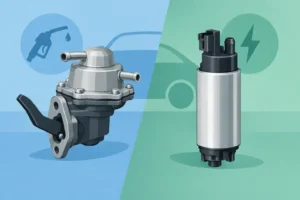
Fuel-system concerns can appear as difficult starting, hesitation, poor acceleration or inconsistent idling. A fuel pump may be involved, but so can a blocked filter, contaminated fuel, electrical connection or engine-management fault. Workshops should confirm fuel pressure and relevant electrical checks before replacing major components. This measured approach controls repair costs and ensures the part fitted addresses the real problem.
Lighting, mirrors and wipers support safer daily use
Some of the most frequently requested Axia parts are also the most visible: headlamps, rear lamps, indicators, grilles, side mirrors and wiper components. Damage from minor impacts is common, while lamps and wipers deteriorate through ordinary use.
Lighting must provide a clear view of the road and make the vehicle visible to others. Clouded, cracked or poorly fitted lamp units can reduce light output or allow moisture ingress. When replacing lighting components, inspect mounting tabs, connectors and beam alignment as well as the unit itself.
Side mirrors are safety equipment, not merely exterior trim. A replacement mirror should match the required specification, including adjustment method and any integrated functions fitted to the vehicle. Wiper blades should clear water cleanly without juddering, smearing or leaving unwiped sections. Replacing worn blades before the rainy season is a simple, valuable recommendation for any customer.
How to source Axia replacement parts efficiently
For dealers and repair businesses, the best purchasing decision balances part quality, accurate fitment, stock consistency and total operating cost. The cheapest option can be costly if it causes a comeback, delays delivery or fails prematurely. Equally, not every repair requires the same product level. The correct choice depends on vehicle condition, usage, customer expectations and the nature of the repair.
A reliable supplier should make it easier to confirm application details, identify equivalent replacement categories and obtain the parts required across routine servicing, braking, cooling, suspension and body repairs. That breadth simplifies purchasing and helps workshops complete more jobs without dealing with multiple sources.
With more than 30 years of aftermarket experience, Multi Top supports trade customers and vehicle owners with dependable replacement parts and practical guidance. The aim is straightforward: keep sourcing efficient, keep repairs moving and help vehicles return to the road with confidence.
For the Axia owner, the most useful habit is not waiting for a warning light or complete failure. Listen for new noises, respond to changes in braking or handling, follow the service schedule and choose parts that support reliable everyday motoring rather than merely the lowest initial price.